
Wire-wound and film platinum sensors can both provide reliable temperature measurement, but they are designed around different priorities. Film sensors are compact, fast-responding and economical, making them well suited to many routine industrial applications. Wire-wound sensors are often preferred for metrology, calibration and other high-accuracy measurements, where long-term stability, low hysteresis and performance over a wider temperature range are especially important. The right choice therefore depends not simply on the required tolerance class, but on how and where the sensor will be used.
Industrial platinum sensors come in two broad constructions: wire-wound, and film types in which platinum is deposited on a ceramic substrate. Both are legitimate technologies with real strengths. TDI manufactures wire-wound platinum resistors, and this article sets out, as evenly as the evidence allows, where wire winding still earns its place.
Wire-wound construction also has a notable pedigree: between the triple point of equilibrium hydrogen at 13.8033 K and the freezing point of silver at 961.78 °C, the International Temperature Scale of 1990 is realised using Standard Platinum Resistance Thermometers (SPRTs), calibrated at specified fixed points. SPRTs are wound from high-purity, well-annealed, strain-free platinum wire — a specialised construction built for reference-level performance, not the same thing as an industrial wire-wound detector, but built on the same basic principle. That has not changed since 1990, and the redefinition of the kelvin in 2019 did not change it either: ITS-90 remains the practical temperature scale, and its reference instrument remains a wound wire.
Two ways to make a platinum resistor
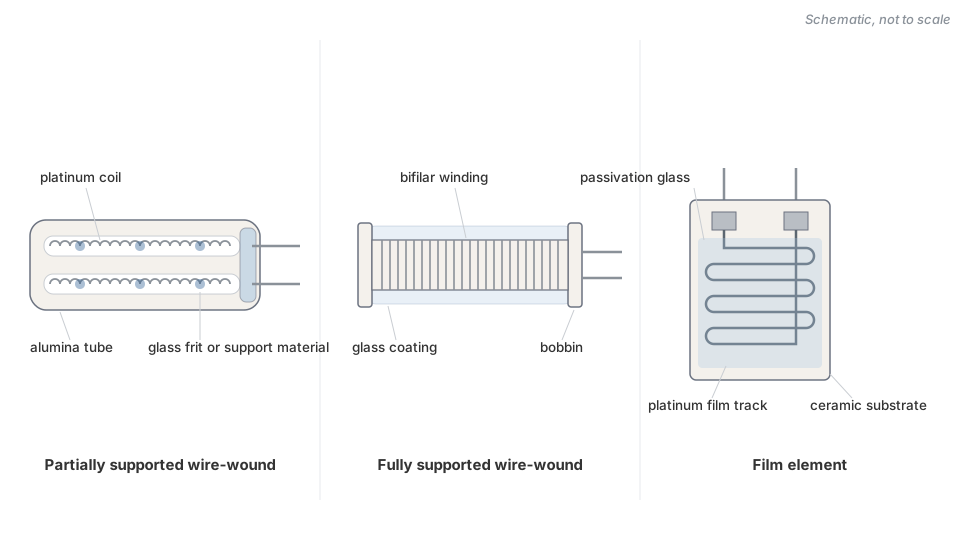
Wire-wound elements themselves divide into two designs.
In the fully supported design, a bifilar winding of platinum wire is wound onto a glass or ceramic bobbin, connected to lead wires, and sealed under a layer of glass. The result is highly robust and is generally preferred where vibration or mechanical shock is significant. The cost is that the wire is bonded to a material whose thermal expansion never quite matches platinum's, so temperature cycling strains the wire, and the element generally shows greater hysteresis and somewhat poorer long-term stability than a less rigidly supported coil.
In the partially supported design, a fine helical coil of platinum wire runs through the bores of a high-purity alumina tube and is fixed along part of its length (or restrained with alumina powder), with the lead junctions sealed in glass or ceramic. The wire is located firmly enough to survive industrial handling, but left sufficiently free to accommodate differential expansion with substantially less strain than a fully supported construction. This is the construction used where performance matters most: the BIPM's guide on industrial platinum resistance thermometers reports a typical accuracy below 0.005 % of range for partially supported coils, against below 0.1 % for fully supported and film types, and notes that the best partially supported elements show hysteresis below 0.0002 % of the temperature span — around 0.2 mK over a 100 °C span, or roughly 1–2 mK over a several-hundred-degree working range.
Film elements are produced by applying platinum to a ceramic substrate. Thick-film sensors are commonly screen-printed from a platinum-bearing paste in layers several tens of micrometres thick; thin-film sensors are commonly sputtered onto high-purity alumina, often to a thickness of a micrometre or less. The resistance pattern is formed by etching, photolithography or laser trimming, then heat-treated and sealed under a passivation layer. Because the platinum is bonded to the substrate across its whole area, the film expands and contracts with the ceramic: strain is built into the sensing mechanism by design. Film sensors can have low hysteresis below roughly 250 °C; at higher temperatures or over wide cycling ranges, substrate coupling, annealing, contamination and structural changes can all limit repeatability and stability.
What the standard's own tables say
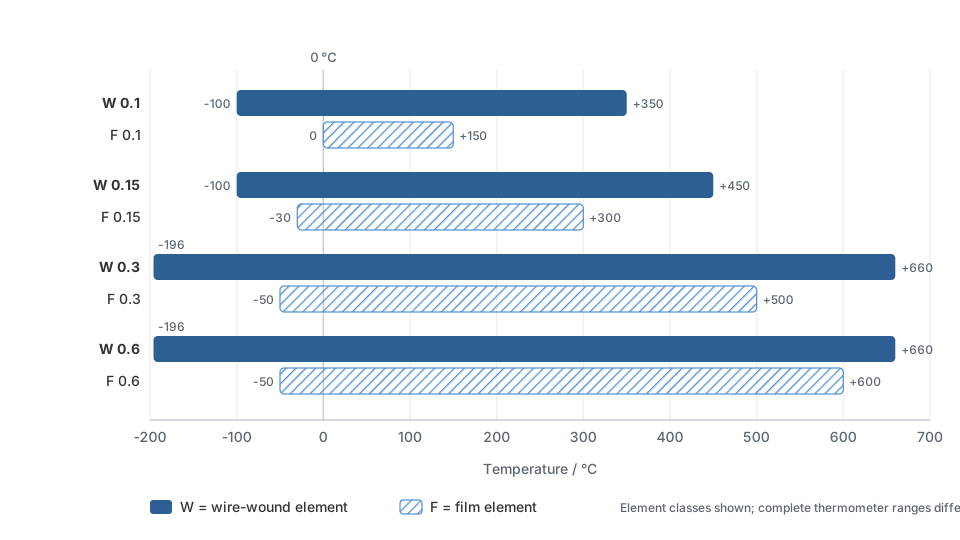
The fairest published comparison of the two technologies is written into IEC 60751 itself. The standard assigns every tolerance class a temperature range of validity, and those ranges, based on working experience with each construction, are consistently wider for wire-wound elements:
| Class tolerance | Wire-wound validity (°C) | Film validity (°C) |
|---|---|---|
| ±(0.1 + 0.0017 |t|) | −100 to +350 | 0 to +150 |
| ±(0.15 + 0.002 |t|) | −100 to +450 | −30 to +300 |
| ±(0.3 + 0.005 |t|) | −196 to +660 | −50 to +500 |
| ±(0.6 + 0.01 |t|) | −196 to +660 | −50 to +600 |
(Element classes W 0.1 to W 0.6 and F 0.1 to F 0.6; the corresponding thermometer classes AA to C carry similar differences. See IEC 60751 Explained.)
The reason is not simply manufacturing spread. In many traditional film designs, manufacture is controlled so that the mean coefficient alpha meets the IEC value, while substrate coupling and film structure can give the element effective A and B coefficients that differ slightly from those of bulk wire. Over a narrow range the difference hides inside the tolerance; over a wide one it emerges, which is why film validity ranges are narrower. Newer optimised film technologies can match the IEC curve more closely. Wire-wound elements generally offer wider tolerance ranges because the platinum can be supported with less substrate-induced constraint — though they are not unconstrained (a fully supported winding is deliberately bonded to its former), and every wire-wound element still remains subject to the validity range of its declared class.
A fair account of film sensors
It would be convenient for a wire-wound manufacturer to say film sensors are inferior. The evidence supports something more specific.
Film sensors are more resistant to mechanical shock than conventional wire-wound detectors, respond faster, occupy less space, offer high nominal resistance values (Pt500, Pt1000) that reduce the fractional effect of lead resistance and can permit lower measuring currents for a given signal voltage, and cost considerably less. Self-heating still depends on the actual power dissipated in the element and is not reduced merely by choosing a higher-resistance type; it must be assessed for the measuring circuit actually used. Early generations earned a poor reputation for long-term stability at higher temperatures, with contamination of the thin platinum layer and reaction with the substrate causing drift; measurement institutes documented cases of thin-film sensors failing to hold Class A across their nominal range. Newer optimised thin-film designs, with substrates engineered to match platinum's expansion, have narrowed the gap considerably, and published work has shown them approaching wire-wound behaviour over moderate ranges.
For a great many industrial measurements (HVAC, machinery, process points measured over a limited span at modest accuracy) a film sensor is a sound and economical choice, and it would be poor advice to specify otherwise.
The distinction that survives all of this is about range and pedigree. Wire-wound sensors remain valid over wider spans in every tolerance class, and a partially supported wire element can be engineered towards the construction and behaviour of the standard thermometers used in calibration laboratories. Platinum lead construction also reduces internal dissimilar-metal junctions within the sensor, cutting one source of thermal EMF — though it does not eliminate thermal EMFs from the complete measurement circuit, which also depends on external connections, terminals and temperature gradients; precision DC measurements normally use current reversal or an equivalent bipolar technique to cancel constant thermal EMFs regardless of sensor construction. Where the requirement is a working standard, a wide operating range, low drift or a low-uncertainty calibration that will still mean something a year later, the industry continues to wind wire — the same basic construction that underpins ITS-90 itself, even though an industrial detector is a different device from an SPRT.
Where wire-wound detectors are the right choice
- Laboratory and working standard thermometers
- High-accuracy thermometry, and thermometers destined for low-uncertainty calibration
- Wide operating ranges, including the −196 °C to +660 °C validity given to wire-wound element classes W 0.3 and W 0.6
- Applications where drift matters more than unit cost
- Applications where platinum lead construction is desirable to minimise internal dissimilar-metal junctions
- Tubular sheathed assemblies, which the coil geometry suits naturally
Note: No element choice rescues a poor installation. Immersion depth, stem conduction, self-heating and gradients routinely contribute more error than the difference between element types. The element sets the floor; the installation decides how far above it you sit.
TDI wire-wound platinum resistors
TDI has manufactured wire-wound platinum detectors in Southport since 1983, producing more than six million to date. All TDI elements are coil-in-alumina constructions — a different family from the generic glass-coated bobbin design described above as "fully supported". Depending on the application, TDI's platinum coil may be partially supported to favour stability and low hysteresis, or supported more fully within the alumina structure — TDI's "totally supported" option — to improve vibration resistance at some cost in hysteresis. Pt25, Pt100 and Pt1000 variants are produced to IEC 60751 and to tighter interchangeability on request.
TDI detectors are used by leading suppliers of high-accuracy industrial platinum thermometers, including Isothermal Technology (Isotech), which uses TDI elements across its industrial, secondary and primary resistance thermometer ranges.
Further reading
- BIPM Consultative Committee for Thermometry, Guide on Secondary Thermometry: Industrial Platinum Resistance Thermometers (bipm.org)
- BIPM, The International Temperature Scale of 1990 (ITS-90) and Mise en pratique for the definition of the kelvin (bipm.org)
- IEC 60751:2022, Industrial platinum resistance thermometers and platinum temperature sensors
- IEC 60751 Explained and What is Alpha? on this site